Carica Furniture Handmade Shop WooCommerce Theme
Antivirus scan
Powered by ClamAV
✅ Verified clean
This product file has passed our security filters.
Want to run a fresh ClamAV scan right now? Takes a few seconds and shows scanner version, signature DB and live result.
This can take 5 to 30 seconds.
Clean file Threat detected
No threats detected in this file.
- File
- Size
- Scanned
- ClamAV
- Signature database
⚡ Powered by ClamAV
Scan could not be completed
Report product
If you detected an issue (broken file, malware, inappropriate content, etc.) let us know and we'll review it ASAP.
Sign in to report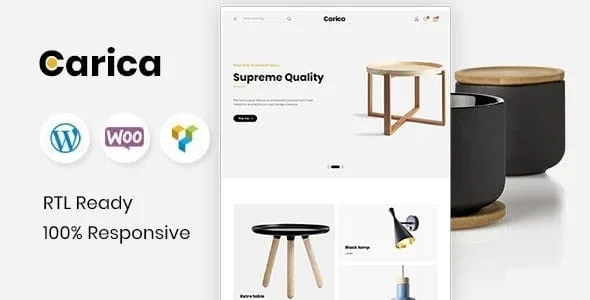
About Carica Furniture Handmade Shop WooCommerce Theme
When the piece is unique, the website does not sell the furniture: it sells whoever makes it
It is the entire difference between a furniture shop and a handmade furniture shop, and it changes what belongs on each page.
In a normal shop, the visitor compares: price, dimensions, lead time, and chooses. They can find the same model on five other sites, so you compete on terms.
With a handmade piece there is no comparison possible, because it exists nowhere else. What the customer is deciding is something else: whether it is worth paying three times as much and waiting six weeks for something a person with a name made. And that does not get decided by looking at the product page: it gets decided by looking at who makes it and how.
Carica is a WooCommerce theme designed for a handmade furniture shop, with a drag and drop builder and plenty of structural options.
What it brings
- A visual drag and drop builder, with customisable header and footer.
- Several homepages and configurable sidebar, menu and breadcrumb structure.
- Grid and list shop views, with instant search.
- WooCommerce catalogue mode, for showing without selling.
- Over forty post grid styles, useful for telling the process.
- One-click demo import, theme options and right-to-left language support.
Catalogue mode is the key feature, and it is counterintuitive
It sounds odd that in a shop the important thing should be being able to remove the buy button, and in this sector it makes complete sense.
Many workshops do not sell from a catalogue: they work to order. The dimensions fit the space, the timber depends what is available, the finish gets chosen together and the price comes after a conversation. Putting a cart there does not help, it confuses.
Catalogue mode lets you show all the work with no price and no cart, replacing the buy button with an enquiry one. That also filters well: somebody writing for a quote on a bespoke sideboard is a far more serious customer than somebody abandoning a cart.
And it is reversible. You can have the made-to-order catalogue without prices while also selling with a cart the small pieces you do have made.
What to tell and hardly anybody tells
The process, with workshop photographs. It is what justifies the price. The rough timber, the hands, the tools, the dust. The theme's forty grid styles are for this, not for a news blog.
Who makes it. With a face and a name. In craft the maker is part of the product, and hiding them throws away your best argument.
The lead time, said before they ask. Six or eight weeks does not frighten anybody if you explain why. Finding out after paying does.
That timber moves. Every piece has its own grain and tone, and it will not be identical to the photograph. Saying so beforehand turns a possible complaint into a selling point.
Requirements
It needs WordPress and WooCommerce. If you sell with delivery, large furniture is charged by volume and delivery, assembly and returns have to be decided before publishing prices.
Alternatives in the catalogue
If your catalogue is series-produced product held in stock, the approach is different: Drile is built around selling furniture with variants and lead times, and MyDecor leans towards homeware and accessories with Elementor.
If as well as making you design interiors, Interico joins portfolio and furniture on the same site.
And if in the end your selling is always by quote rather than by cart, the piece that genuinely solves that is Request a Quote, which turns the buy button into a price request with the handling behind it.
Frequently asked questions
Can I show the furniture without selling it?
Yes, with catalogue mode, which removes price and cart. It is the norm when you work to order.
Does it need an external builder?
It brings its own visual builder, with customisable header and footer.
Can I also sell finished pieces?
Yes, it can be combined: a catalogue without prices for commissions and a cart for what is in stock.
What should a unique piece's page carry?
The process, who makes it, the real lead time and the note that timber varies between pieces.
How do I handle quotes?
With a form, or with a quote request plugin if the volume calls for it.
And delivery?
Large furniture is charged by volume. Delivery, assembly and returns get decided before publishing prices.
Topics
Version history
-
v
1.2 Current 16 Jun 2024
Customer reviews
Sign in to leave a review. Only people who have the product can review it.
No reviews for this product yet.
Frequently asked questions
-
GPL (General Public License) is the license under which WordPress and most premium plugins/themes are distributed. It grants you the right to use, modify and redistribute the software in as many projects as you want, with no domain restrictions.
-
Yes. With membership you get automatic updates via our GPLClub Updater plugin (installed on your WP, detects new versions and applies them). With individual purchase, you get one year of manual updates from your account.
-
Depends on the plan. Monthly: 3 domains. Semi-annual: 7. Annual and Lifetime: 15. Individual purchase: 1 domain.
-
GPLClub offers its own support for installation, configuration and compatibility. For direct support from the original author (feature requests, product-specific bugs), a license purchased from the author is required.