Interico – Interior Design & Architecture WordPress Theme
Antivirus scan
Powered by ClamAV
✅ Verified clean
This product file has passed our security filters.
Want to run a fresh ClamAV scan right now? Takes a few seconds and shows scanner version, signature DB and live result.
This can take 5 to 30 seconds.
Clean file Threat detected
No threats detected in this file.
- File
- Size
- Scanned
- ClamAV
- Signature database
⚡ Powered by ClamAV
Scan could not be completed
Report product
If you detected an issue (broken file, malware, inappropriate content, etc.) let us know and we'll review it ASAP.
Sign in to report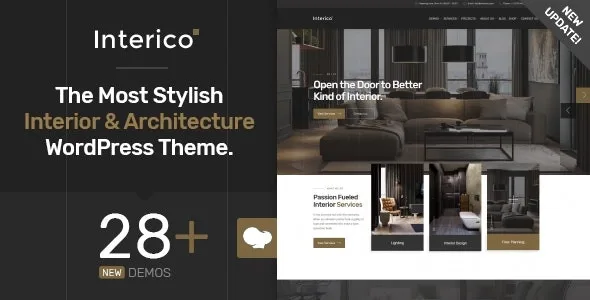
About Interico – Interior Design & Architecture WordPress Theme
The interior designer who also sells the pieces they specify
It is a widespread business model and one very badly served by the sector's websites. The practice designs the living room, chooses the sofa, the lamp and the rug, and then the client goes off and buys them somewhere else. All that margin is lost.
Whoever closes the loop sells the pieces too: on commission with the supplier, by direct resale, or with a curated selection of their own. And there the website has to do two things at once that hardly ever coexist: show projects with large imagery and sell product with a page, a price and a cart.
Interico is designed at exactly that junction: interior design, architecture and furniture.
What it contributes
- A project portfolio for interior design and architecture.
- A furniture side, for presenting or selling the pieces.
- Practice pages with services and presentation.
- Sector aesthetics, with style and the image as the protagonist.
How the two halves connect
Here is the detail that separates a site that sells from a pretty catalogue, and it does not depend on the theme but on how you build it.
The piece that works is linking the project to the products that appear in it. The visitor looks at the finished living room, likes the lamp, and from that same photograph reaches the lamp's page. That journey is what turns inspiration into an order, and it is what interiors magazines have done for decades.
The reverse works too: from the product page, showing which projects it has been used in. A chair in a studio photograph gets looked at; that same chair in a real dining room, in afternoon light with the table laid, gets bought.
None of this is automatic. It is the work of building the links one by one, and it is the work almost nobody does.
The usual warning in this sector, and it is serious
If you genuinely sell furniture, with a cart and payment, the problem is not the website: it is the delivery. A sofa does not fit into normal shipping arithmetic, and you have to decide beforehand whether it is delivered to the door or into the house, whether it goes up stairs, whether it gets assembled, and what happens when it arrives scuffed.
Add to that the right of withdrawal: fourteen days to return, and a large item has to be collected. Those costs have to be in the price from day one.
If for now you only want to present and earn commission, the supplier absorbs all of that, and it is a perfectly reasonable way to start.
Requirements
It needs WordPress, and WooCommerce if you are going to genuinely sell. The demo images carry their own licence and have to be replaced.
Alternatives in the catalogue
If your business is only the practice and you will not sell product, half the theme is surplus: Hiroshi is pure contemporary portfolio, Brok adds project pages with data, and Ollis covers the ground with several demos.
If it is the other way round and yours is mainly the shop, with a broad furniture catalogue, then you need a commerce theme: Drile is built for that, with many product page layouts, and MyDecor is another option on Elementor.
If you prefer building the design with Elementor templates over your current theme, Nordicus is the catalogue's minimalist option.
And for presenting projects with movement, Motion.page builds scroll animations without writing code.
Frequently asked questions
Is it suitable for selling furniture?
It allows for the furniture side. For a genuinely large catalogue, a shop theme fits better.
Can I link products from the projects?
Yes, and it converts best, although those links have to be built by hand.
Does it need WooCommerce?
Only if you are going to charge. For presenting pieces without selling them, no.
What about furniture delivery?
It does not fit normal shipping arithmetic. Delivery, assembly and returns have to be decided before publishing prices.
Can I use the demo images?
No. They carry their own licence and have to be replaced.
Does it work for a practice with no shop?
Yes, although then there are more direct portfolio themes.
Version history
-
v
1.1.3 Current 18 Jun 2024
Customer reviews
Sign in to leave a review. Only people who have the product can review it.
No reviews for this product yet.
Frequently asked questions
-
GPL (General Public License) is the license under which WordPress and most premium plugins/themes are distributed. It grants you the right to use, modify and redistribute the software in as many projects as you want, with no domain restrictions.
-
Yes. With membership you get automatic updates via our GPLClub Updater plugin (installed on your WP, detects new versions and applies them). With individual purchase, you get one year of manual updates from your account.
-
Depends on the plan. Monthly: 3 domains. Semi-annual: 7. Annual and Lifetime: 15. Individual purchase: 1 domain.
-
GPLClub offers its own support for installation, configuration and compatibility. For direct support from the original author (feature requests, product-specific bugs), a license purchased from the author is required.